Bond to Be Free
- Godess Joy Sanders
- Aug 13
- 3 min read

Updated: Aug 14

There is a beautiful paradox at the heart of Shibari:
Sometimes, we need to be held in order to feel free.
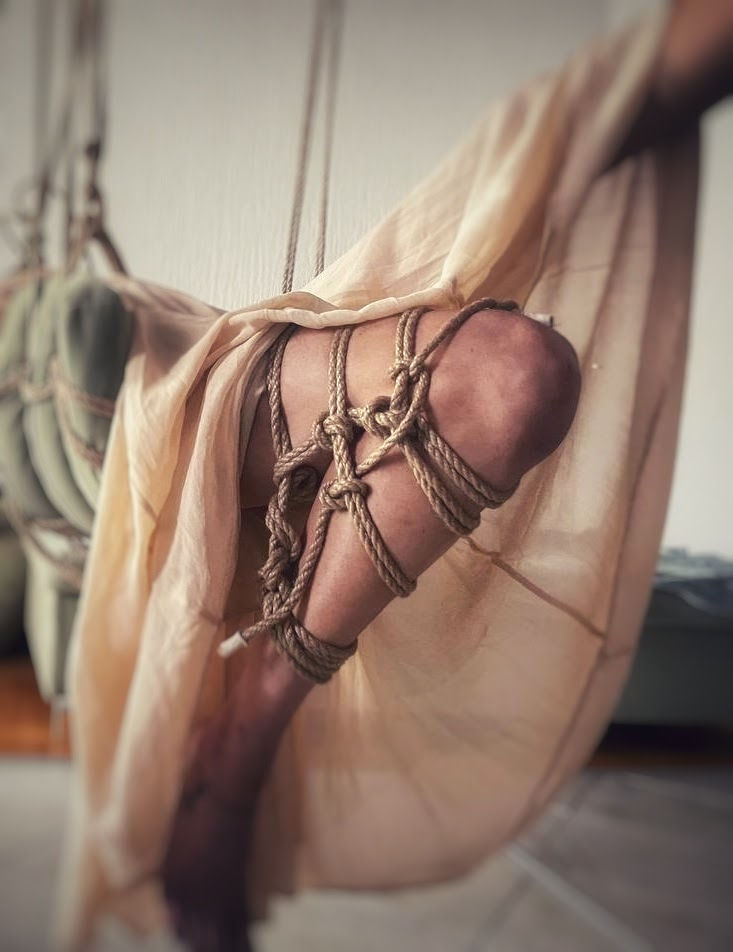
Rope can create boundaries, structure, and connection. Yet within those boundaries, something unexpected can happen — the mind becomes quieter, the body becomes more present, and we begin to notice what is happening inside us.
This is where Shibari can become more than an art of knots and patterns. It can become a somatic practice — an exploration of sensation, breath, movement, trust, communication, and presence.
The Body Knows
We spend much of our lives inside our heads.
Thinking about what happened yesterday. Planning what needs to happen tomorrow. Trying to control outcomes, meet expectations, and keep moving.
Rope invites us to pause.
As the rope makes contact with the body, attention naturally moves toward sensation. We begin to notice pressure, temperature, tension, breath, movement, and stillness.
Instead of asking, “Am I doing this correctly?”, we can begin asking:
What am I feeling?
Can I breathe comfortably?
Where am I holding tension?
What does my body need right now?
This shift from performance to awareness can be deeply transformative.
Being Held Is Not the Same as Being Controlled
To be held does not have to mean giving away your voice or your agency.
In conscious rope practice, being held can mean entering a space where communication matters more than perfection.
A pause matters.
A breath matters.
A change in sensation matters.
A boundary matters.
The rope becomes part of a conversation between people — a conversation that doesn't always need words.
When practiced with awareness and consent, rope can offer a unique experience of support without taking away autonomy.
You can be held and still be completely yourself.
Freedom Within Boundaries
We often imagine freedom as the absence of limitations.
But the human body understands something different.
A dancer needs structure to move.A musician needs rhythm to create.A painter needs a canvas.And sometimes, the body needs boundaries to explore movement more deeply.
Rope creates physical boundaries, but those boundaries can become a container for exploration.
Within them, we may discover movement we didn't expect, sensations we had forgotten, or simply the ability to stay present with ourselves.
The rope doesn't have to define who we are.
It can simply give us a place to explore.
Connection Begins With Listening
Somatic Shibari is not only about the person being tied.
It is also about the person holding the rope.
Both people are participating in an ongoing dialogue.
The rigger listens through their hands.The person in rope listens through their body.Both communicate through breath, movement, words, pauses, and subtle changes in energy.
This is why conscious rope practice asks us to slow down.
Instead of rushing toward a particular shape or technique, we can become curious about the experience itself.
What happens when we listen before we act?
Rope as a Practice of Presence
There is something powerful about giving your full attention to another human being.
No phone.
No distractions.
No rushing.
Just breath, rope, movement, and awareness.
For a moment, the outside world can become quieter.
This doesn't mean that Shibari needs to be mystical or that every experience has to be profound. Sometimes the practice is simply about learning to notice.
Noticing your breath.
Noticing your posture.
Noticing tension.
Noticing trust.
Noticing when something feels good — and when something doesn't.
That awareness is valuable far beyond the rope.
The Courage to Say Yes — and No
One of the most important aspects of somatic rope practice is understanding that consent is not a single moment.
It is an ongoing conversation.
“Yes” matters.
“No” matters.
“Not yet” matters.
“Can we change this?” matters.
“Soften the tension” matters.
“Let's stop” matters.
True connection doesn't come from ignoring boundaries. It comes from knowing that boundaries will be respected.
Paradoxically, that sense of safety can create more freedom to explore.
Bond to Be Free
Perhaps this is the greatest paradox of rope.
We enter the ropes to experience connection, yet the deeper invitation may be to reconnect with ourselves.
To feel rather than perform.
To listen rather than assume.
To breathe rather than rush.
To discover where we are holding on — and where we might finally be ready to let go.
Bond to be free.
Not because the rope takes our freedom away.
But because, within a safe and conscious container, we may discover a different kind of freedom:
The freedom to be present.
The freedom to communicate.
The freedom to feel.
The freedom to trust.
The freedom to inhabit our own bodies with greater awareness.
And perhaps, ultimately, the freedom to simply be.
Shibari Montenegro is an invitation to explore rope not only as an art, but as a practice of connection, embodiment, creativity, and conscious presence.
Come curious.
Come slowly.
Come as you are.
Bond to be free.


Comments